
Winterize Your Home

With freezing temperatures right around the corner, it’s a good time to refresh ourselves on precautionary measures for drops in temperature and cold weather.

The Four P’s to Prepare your Home this Winter:

  • People
  • Pets
  • Pipes
  • Plants

People

  • Avoid going outside if it is not necessary. If you do, make sure you layer up from head to toe.
  • To keep you and your family safe, it is imperative your home is warm.
  • Make sure your heat is set to an appropriate temperature to make your entire home comfortable. Remember, heat rises so if you sleep upstairs, your room may be warmer than rooms downstairs.
  • If you use a fireplace, make sure you have a screen to catch any embers that might escape or a rolling log.
  • Never use your stove or oven to heat your home.
  • If you smell smoke or see flames, call 9-1-1 immediately.

Pets

  • While protecting your family, it is imperative to protect your pets as well.
  • Pets, like humans, are vulnerable to cold temperatures. If not taken care of properly, they can succumb to frostbite and even hypothermia.
  • If you have a dog that typically lives outdoors, consider letting them inside when temperatures drop to freezing. While their fur does help to keep them warm, it provides little help in freezing temperatures.
  • If you absolutely cannot bring them inside, make sure they have a warm shelter, plenty of food and fresh water so it does not freeze.
  • If your pet looks like it has any symptoms resembling frostbite or hypothermia, call your vet.

Pipes

  • Turn off the sprinkler system shut-off valve. Most residential devices have two shut-off valves. These are typically covered in blue on the valve handles and located before and after the sprinkler system backflow device. A diagram is shown below.
  • Release the water pressure from the bleeder valves. The bleeder valves are usually located under the top of the backflow device. If the water does not stop flowing you may have not shut the valves off completely.
  • Leave the smaller bleeder valve open, this will let any remaining water in the line expand without breaking the device. Insulate your backflow device. Most hardware/home services stores carry backflow insulation supplies.
  • Make sure to cover all your exposed pipes with a cover. You can also cover your pipes with towels, duct tape or another adhesive strip as long as they are wrapped tightly.
  • You can also open up the cabinets to let warm air circulate throughout your home. Just make sure any harmful chemicals are out of reach for children and pets.

Plants

  • When cold weather hits, it’s a good idea to bring in all of your outdoor plants.
  • If you can’t bring in the plant, cover it with a blanket to make sure they do not die.

Other Tips

  • Don’t forget to make sure your car is okay for the freezing temperatures. Check your anti-freeze and your batteries. Also make sure to check your tire pressure and the tread.
  • Speaking of cars, make sure when you are on the road that you are mindful parts of the roads may be frozen, particularly bridges. Do not speed and never slam on the brakes.
  • Make sure if you use a generator, it is outdoors. Do not use a generator inside, including in your garage.
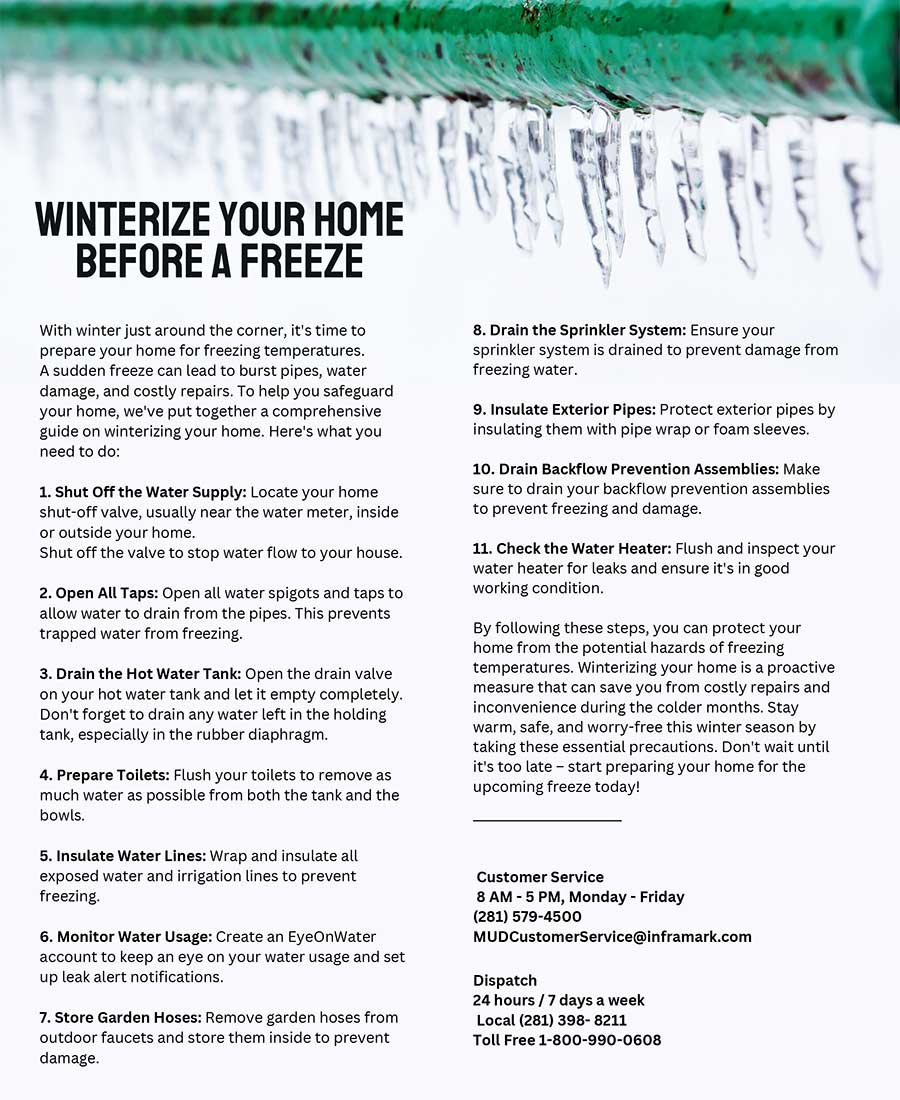
Winterize Your Home2026-01-23T12:36:17-06:00

Arctic Weather Alert

Wind has a major impact on whether exposed pipes freeze, even when the air temperature alone might seem marginal. Here’s how it works in practical terms:

1. Wind accelerates heat loss (wind chill effect)

  • Wind strips away the thin layer of warmer air that naturally surrounds a pipe.
  • This increases convective heat transfer, causing the pipe to lose heat much faster.
  • Even though wind chills don’t lower the actual air temperature, it lowers the effective temperature of the pipe surface, making freezing more likely.

Example: At 28°F (−2°C) with strong wind, an exposed pipe can cool as fast as it would in much colder, calm conditions.

2. Pipes freeze faster in windy conditions

  • In still air, pipes may retain some heat from:
  • Residual warm water inside
  • Heat leaking from nearby buildings or the ground
  • Wind removes that heat continuously, allowing the pipe temperature to drop below 32°F (0°C) more quickly.

This is why pipes often freeze:

  • On north-facing or windward sides of buildings
  • In crawlspaces, attics, or under homes with air infiltration
  • On bridges or elevated structures

3. Wind defeats insulation if it’s not sealed

  • Insulation works by trapping air.
  • Wind penetrating gaps or poorly sealed insulation nullifies its effectiveness.
  • Even insulated pipes can freeze if wind is allowed to blow through or behind the insulation.

Key point: Insulation must be continuous, sealed, and wind-blocked to be effective.

4. Evaporative cooling can worsen freezing

  • If moisture is present (rain, melting snow, condensation), wind speeds up evaporation.
  • Evaporation pulls additional heat from the pipe, lowering its temperature further.
  • This is especially dangerous around outdoor faucets and irrigation lines.

5. Why moving water helps—but wind can still win

  • Flowing water resists freezing because it brings in heat from upstream.
  • However, in strong wind and prolonged cold:
  • Slow trickles may not provide enough heat
  • Small-diameter pipes can still freeze

Practical mitigation strategies

To reduce wind-related freezing risk:

  • Block wind exposure (plywood shields, skirting, or wind barriers)
  • Seal insulation with tape or vapor barrier
  • Use heat tape rated for outdoor use
  • Enclose pipes where possible

Bottom line
Wind dramatically increases the freezing risk of exposed pipes by accelerating heat loss. In freezing weather, a windy 28°F night can be far more dangerous to pipes than a calm 20°F night.

There are several effective methods to keep your exposed pipes from freezing. Here are some of the most common ones:
1. Insulation:

  • Use foam pipe insulation, heat tape, or heat cable to wrap pipes.
  • Make sure to cover all joints and bends thoroughly.

2. Enclosures and Barriers: Build insulated boxes or enclosures around vulnerable pipes.

  • Use plywood or other wind barriers to block strong gusts.

3. Sealing Gaps:

  • Seal any cracks, gaps, or openings in walls, floors, and foundations where cold air can seep in.

4. Heating Solutions:

  • Install a small space heater or heat lamp in areas with exposed pipes.
  • Use heat tape or cables that are thermostatically controlled to maintain a safe temperature.

5. Keeping Indoor Temperatures Consistent:

  • Maintain consistent heat in areas where pipes are exposed, such as attics, basements, or crawl spaces.

6. Disconnecting and Draining:

  • For outdoor hoses and sprinkler systems, disconnect and drain them before freezing weather sets in.

7. Using Outdoor Faucet Covers:

  • Install insulated covers over outdoor faucets to help protect them from the cold.

By combining several of these methods, you can significantly reduce the risk of frozen pipes. If you need more details on any of them, just let me know!

As a reminder from Winter Storm Uri, Senate Bill 3 was passed in 2021 which prevents penalties and water service terminations during an “extreme weather emergency.” This is defined as a period when the previous day’s highest temperature and the predicted temperature for the next 24 hours are both no higher than 28 degrees Fahrenheit.

If you have any issues, please contact Inframark at 832-467-1599

Arctic Weather Alert2026-01-22T21:53:07-06:00

WHCRWA Withdrew Implementation of Stage 2

The West Harris County Regional Water Authority (the “Authority”) withdrew implementation of Stage 2 of its Drought Contingency Plan and reinitiated implementation of Stage 1 of its Drought Contingency Plan.

Under Stage 1, the Authority continues to request all water users to voluntarily reduce their water usage. The Authority will continue to monitor water use and will provide another notice if the drought stage changes or if Stage 1 drought conditions have been lifted. Please keep in mind that, despite the recent cooler and wetter conditions, drought conditions remain in the Houston region.

WHCRWA Withdrew Implementation of Stage 22024-01-15T00:44:56-06:00

Water Main Break Repaired- 9/20/2023 @ 9:00 p.m.

The water main break on Pine Falls Drive has been repaired. Should you have any questions or concerns you can contact the District’s Water Operator at (281) 375-5982.

Water Main Break Repaired- 9/20/2023 @ 9:00 p.m.2024-01-15T00:45:07-06:00

Water Main Break- 9/20/2023 @ 3:30 p.m.

The District is aware of a water main break on Pine Falls Drive, affecting around 15 home. There is no ETA for repair at this time. We will update residents as we know more.

Water Main Break- 9/20/2023 @ 3:30 p.m.2024-01-15T00:45:13-06:00

Stage 2 of the Drought Contingency Plan

NHCRWA implements Stage 2 of the Drought Contingency Plan

The City of Houston (COH), the primary source of water for the North Harris County Regional Water Authority (Authority), has entered stage two of their Drought Contingency Plan, effective on August 27, 2023. The COH’s drought response calls for mandatory water conservations efforts to reduce water use, that will reduce the daily volume of water delivered. The Houston Public Works Release can be found under https://cityofhouston.news/stagetwodrought/ .

As required by the Authority’s Drought Contingency Plan, the Authority must enter Stage 2 of our Drought Contingency Plan, when the COH enters into Stage 2 water shortage of their Drought Contingency Plan. The Authority’s Drought Contingency Plan requires that any customer receiving water from the Authority or well owner whose well is included under the Authority’s Harris-Galveston Subsidence District aggregate water well permit:

  • Repair detectible water leaks within 72 hours of discovery;
  • Utilize water conservation measures such as displacement bags, low-flow shower heads and leak detection tablets. Additional water conservation tips can be found at www.irrygator.com;
  • Limit outdoor irrigation to the hours 7:00 p.m. and 5:00 a.m. of the following day on no more than two (2) days per week, in conformity with the following schedule (no watering on Mondays):
    • Sundays and Thursdays for single-family residential customers with even-numbered street addresses
    • Saturdays and Wednesdays for single-family residential customers with odd-numbered street addresses; and
    • Tuesdays and Fridays for all other customers

Compliance with the above requirements is mandatory.

Stage 2 of the Drought Contingency Plan2023-10-12T17:20:56-05:00

Water Main Break- 8/15/2023 @ 4:00 p.m.

The District is aware of a water main break near 15835 Pinyon Creek Drive. Crews have been notified and will be on-site as soon as possible to make the repairs. At this time there is no ETA. Check back for updates.

Water Main Break- 8/15/2023 @ 4:00 p.m.2024-01-15T00:45:24-06:00

Water Main Break Repaired- 8/7/2023 @ 7:00 p.m.

The secondary water main break has been repaired. Should you have any questions or concerns you can contact the District’s Water Operator at (281) 375-5982.

Water Main Break Repaired- 8/7/2023 @ 7:00 p.m.2023-08-15T16:10:37-05:00
Go to Top